
Are Connecticut Mugshots Public?
Connecticut opens its record of arrest to the public from the moment of the arrest. That promise stops short of photos. Nothing in the rule guarantees a booking photo will be released, posted, or kept in a live search tool. The statute's minimum fields leave photographs out. Requesters must ask for the image separately. The agency then weighs it under public-record, privacy, safety, sealing, and investigation rules. Connecticut runs no county sheriff or county jail system. Municipal police and Connecticut State Police make the arrests. The Judicial Branch holds the case layer, and the state Department of Correction covers state custody.
Access turns on the record and its custodian. A police log can state arrest facts without an image. A case-file photo may never be indexed for public browsing, so the exemption question matters as much as the record itself.
What Connecticut Arrest Records Include
The public arrest-record floor sits in the Connecticut General Statutes (C.G.S.) § 1-215. The presumption and exemptions in § 1-210 still matter. Section 1-212 handles copies and fees. The statute lists certain arrest information; it does not open every paper, image, or investigative item in a police file.
| Record item | What the law says |
|---|---|
| Basic arrest facts | Name, race, address, date, time, and place of arrest, plus the offense for which the person was arrested. |
| Warrant arrest | The warrant application and affidavit are included, subject to a court seal. If part is sealed, the statute provides for a non-prejudicial summary. |
| Warrantless arrest | The official arrest report, incident report, or similar report is included, subject to the statute's limits and redactions. |
| Booking photo | A photo is not named in the minimum definition. Ask for it separately; release requires an agency review. |
| Excluded material | The definition excludes juvenile arrest records, erased records under chapter 961a, and investigative files. |
Section 1-215 permits narrow redactions. Witness identity, protected victim details, material that could harm a pending case or likely law-enforcement action, and judge-sealed information can all come out. Custody records may need a separate FOI review. The state's attorney receives notice in that process.
For current §§ 1-210, 1-212, and 1-215, name the arrest record and the photo separately in any request. Then ask the custodian to state the legal basis for each withheld part.
The official chapter 14 text shows where Connecticut places the access rules for public records, copies, and arrest records.
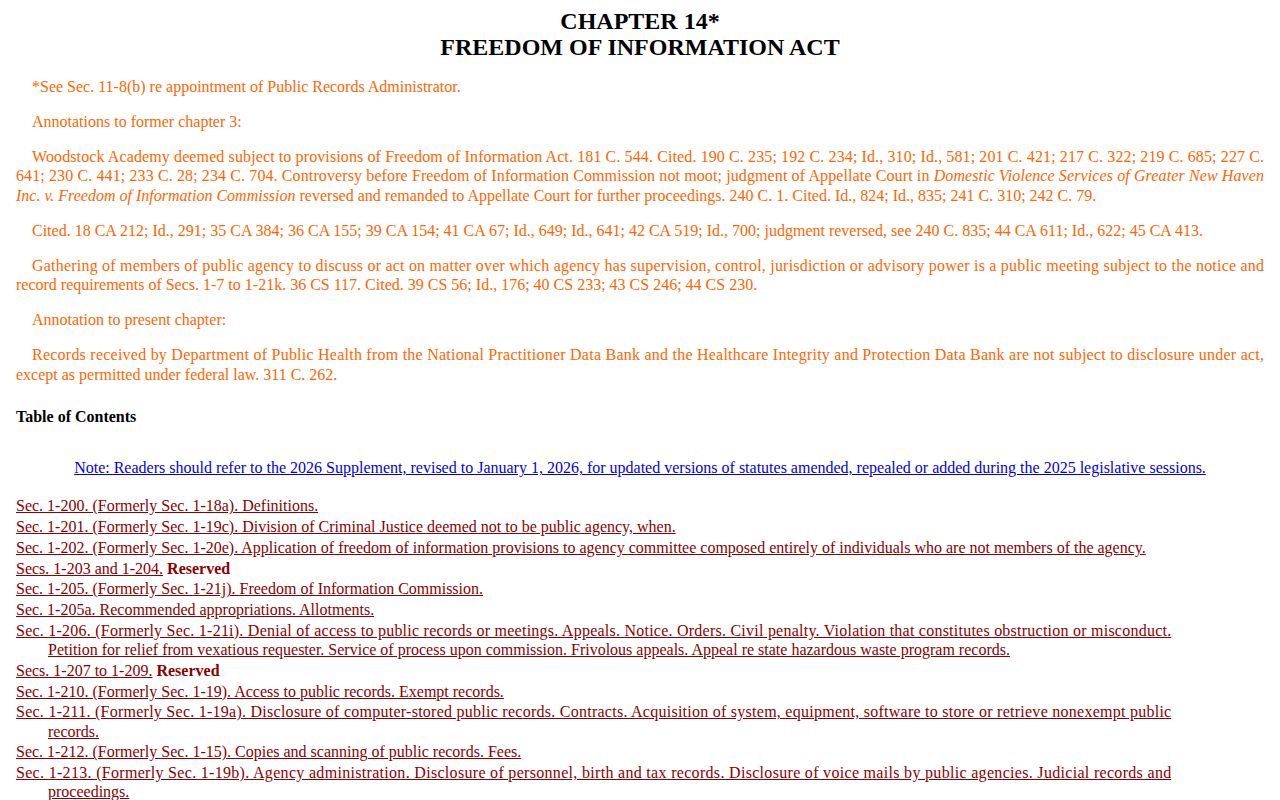
The statute page is only a starting point. Each agency still decides whether a specific photo is exempt. Nothing requires an online roster. Note: A public arrest record can exist even when the arresting agency publishes no mugshot feed.
Why Connecticut Mugshots May Be Withheld
Juvenile arrest records fall outside § 1-215 entirely. Connecticut's youthful-offender rules add a separate protected status under state law. That shield covers fingerprints, photos, and physical descriptions unless an exception applies. CT DOC's public search excludes them. A missing result proves nothing about whether an event occurred. Never infer a protected identity from a name match.
Other limits abound. A court seal can qualify. So can a pending investigative file, witness identity, protected victim details, or material that could prejudice a case. Ask for whatever can be separated from the exempt parts. C.G.S. § 1-17a concerns certain state-agency ID-card images. It is not a mugshot statute. Apply the arrest-record, FOI, erasure, youth-confidentiality, and court-order rules instead.
Note: A juvenile or youthful-offender photo should never be republished or identified through an adult-facing search result.
Connecticut Mugshot-Law History
Public acts such as P.A. 83-272, P.A. 94-117, and P.A. 94-246 shaped today's rules, and § 1-215 took its modern form in 1999. Later amendments included P.A. 15-164 and P.A. 19-43 on victim protections. A 2014 General Assembly hearing aired mugshot-website complaints. A hearing is not an enacted removal right.
No general Connecticut statute bars private publication of a lawfully obtained mugshot. No statute orders free removal. None makes a removal fee a standalone offense, either. The current chapter's legislative history helps separate enacted law from stalled proposals.
Martin v. Hearst Corporation, 777 F.3d 546 (2d Cir. 2015), tested erasure's reach. A newspaper had accurately reported an arrest. The charges were later nolled, meaning ended without trial, and the record was erased. The Second Circuit rejected liability. The publisher had simply kept an accurate old report. Official erasure and an archived story can coexist. The ruling leaves other correction, privacy, and defamation claims open, so apply current § 1-215 and its exceptions; the Martin opinion materials show the court's reasoning.
How Connecticut Erasure Works
Connecticut's central remedy for criminal records goes by a distinct name: erasure. C.G.S. § 54-142a reaches dismissals, nolles, acquittals, qualifying pardons, decriminalized conduct, some cannabis matters, and eligible Clean Slate records. The routes to erasure vary. Disclosure limits sit in § 54-142c, and § 54-142t builds the automated system. Neither statute wipes every copy that circulates online.
A second layer of law targets bulk buyers. Section 54-142e applies to recipients who purchase public criminal matters from a state agency or file a "mass request" with the Judicial Department or a criminal-justice agency. Fifty or more matters make a request a mass request. Covered recipients must track the agency's update schedule and delete an erased record within 30 calendar days of receiving erasure information. Beyond that, disclosure is barred unless a law allows it. The Attorney General can pursue an order under the statute, and violations count as unfair or deceptive trade practices under CUTPA.
The official criminal-records chapter displays the automated-erasure provisions and the limits on destruction of paper records.
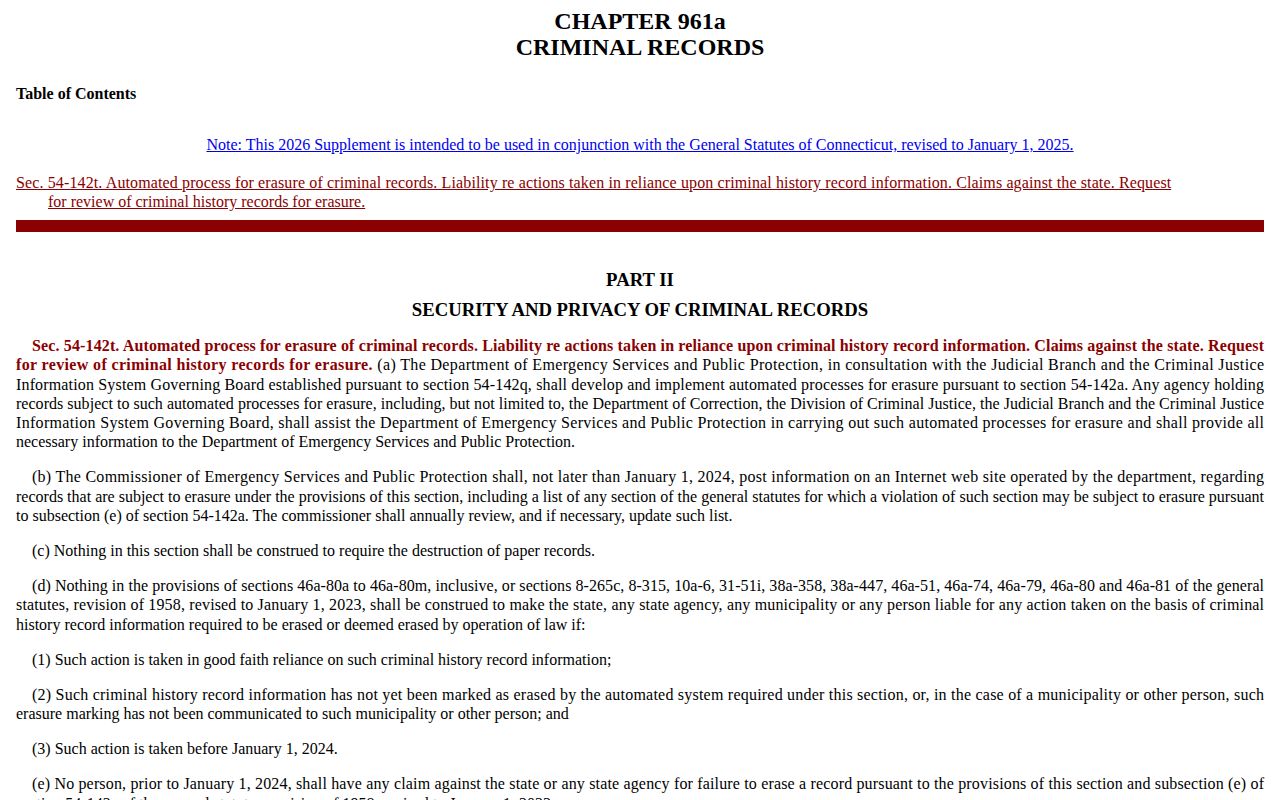
Erasure, a photo the agency keeps, and a private webpage each carry their own legal weight. Note: Section 54-142e's 30-day deletion clock starts when a covered recipient receives erasure information, not when someone asks a website to pull a photo down.
Clean Slate Waiting Periods
Not every Connecticut conviction qualifies under Clean Slate. Matters from January 1, 2000 onward may become eligible once a waiting period passes, the sentence is complete, and no new crime occurred in the meantime. Offense type, class, and sentence still control the outcome.
- Some misdemeanors punishable by less than one year may qualify after seven years from the most recent conviction.
- Some class D or E felonies and unclassified felonies punishable by less than five years may qualify after ten years from the most recent conviction.
- A conviction under C.G.S. § 14-227a may fall within the ten-year category when the other statutory conditions are met.
- The sentence must be complete, including prison, parole or special parole, and probation, and there must be no new crime during the wait.
- Listed exclusions include family-violence crimes on or after January 1, 2000, specified nonviolent or sexually violent offenses, firearm and violence offenses, and repeated DUI circumstances.
Automatic erasure began in 2023 for certain cannabis convictions. Other cannabis cases, plus older non-cannabis ones, may require a petition. Pre-2000 offenses follow the petition path the state describes. Current categories and exclusions appear in the official eligibility summary linked below.
Think a record was skipped? The state advises pulling a current criminal-history record from the State Police Bureau of Identification. Fill out the DESPP hearing form and submit it as instructed. The Bureau of Identification details the record route. The petition page walks through court filing.
The state eligibility page summarizes the waiting periods and offense limits behind automated Clean Slate erasure.
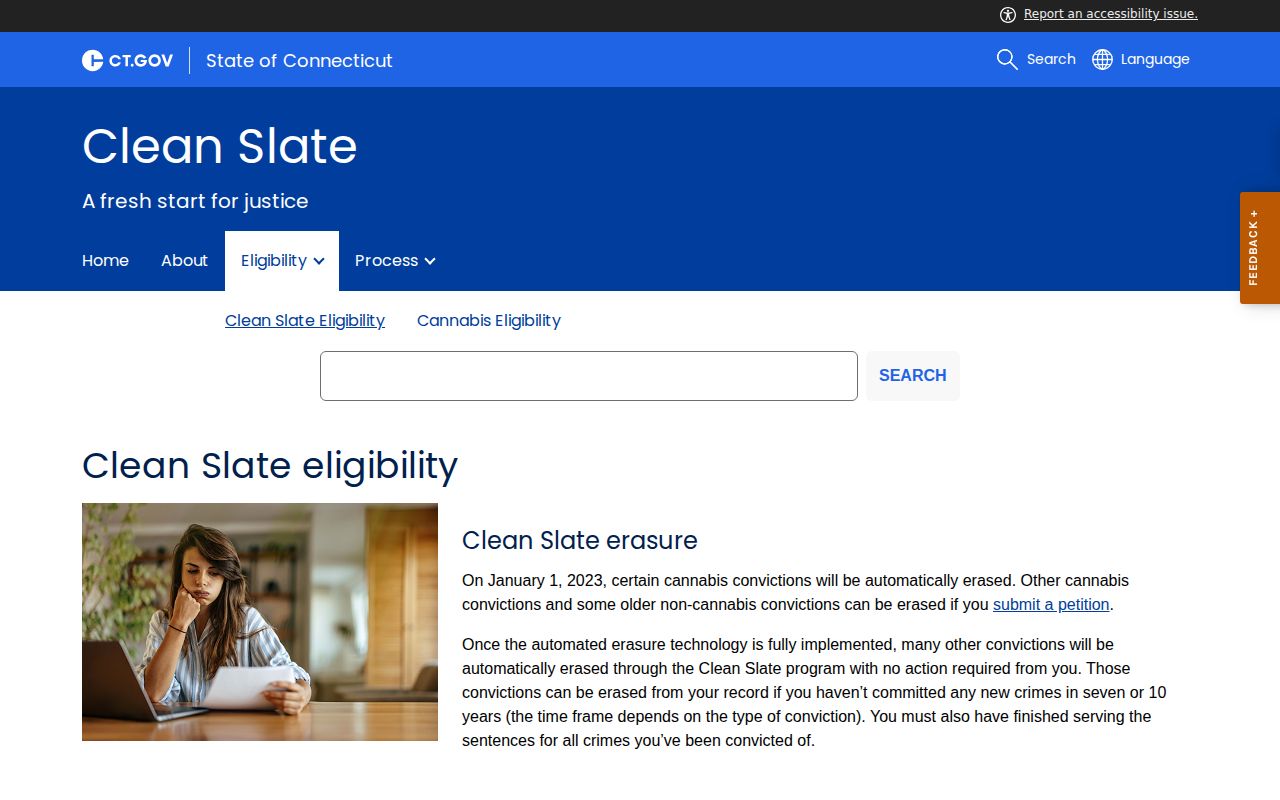
Time alone proves nothing. Check the disposition and the state's current test before assuming a charge was erased.
When Erasure Leaves a Photo Behind
Erasure is not destruction. Section 54-142t does not mandate destroying paper records. The State Library's M7 schedule ties municipal fingerprints, mugshots, physical descriptors, and recordings to the life of a case file. Disposal comes under a signed RC-075. Some Department of Public Safety identification material is kept for 80 years. Certain juvenile or youthful-offender records carry special disposal terms at age 21. That applies when no recurring offense or adult transfer exists.
Treat M7 as retention guidance. It is not a guarantee that every photo stays visible or public the whole time. A live roster can drop a name while an agency archive holds the record. So ask whether an image sits in the erased case file or stands as a separate identification record. Which access rule governs it? The State Library schedule spells out the record series.
Note: A photo's disappearance from a live roster proves little. The agency may still hold the source record.
Free Connecticut Mugshot Corrections
Begin with the record owner. Wrong arrest date, identity, charge, or disposition? Ask the police agency or court that created the record to review it at the source. Confirm erasure before approaching a publisher about a copy, since one source fix cannot rewrite every old article or repost elsewhere.
- Save the exact page address and identify the error or final court outcome.
- Get proof from the court or agency, such as a disposition record or erasure confirmation, and share only what the stated process asks for.
- Use the publisher's published free correction or opt-out route. State the requested change and link to the record that needs review.
- After the source page changes, use the search engine's own outdated-result process if a stale listing remains in search.
RecentlyBooked describes its process as free and accepts dismissal, erasure or sealing, a wrong or outdated entry, juvenile status, and duplicates as possible grounds. Listing details and supporting records are requested. Remember the policy is voluntary, not a statutory right or a promise of approval.
The free RecentlyBooked policy describes the records and documents its staff asks a requester to provide.
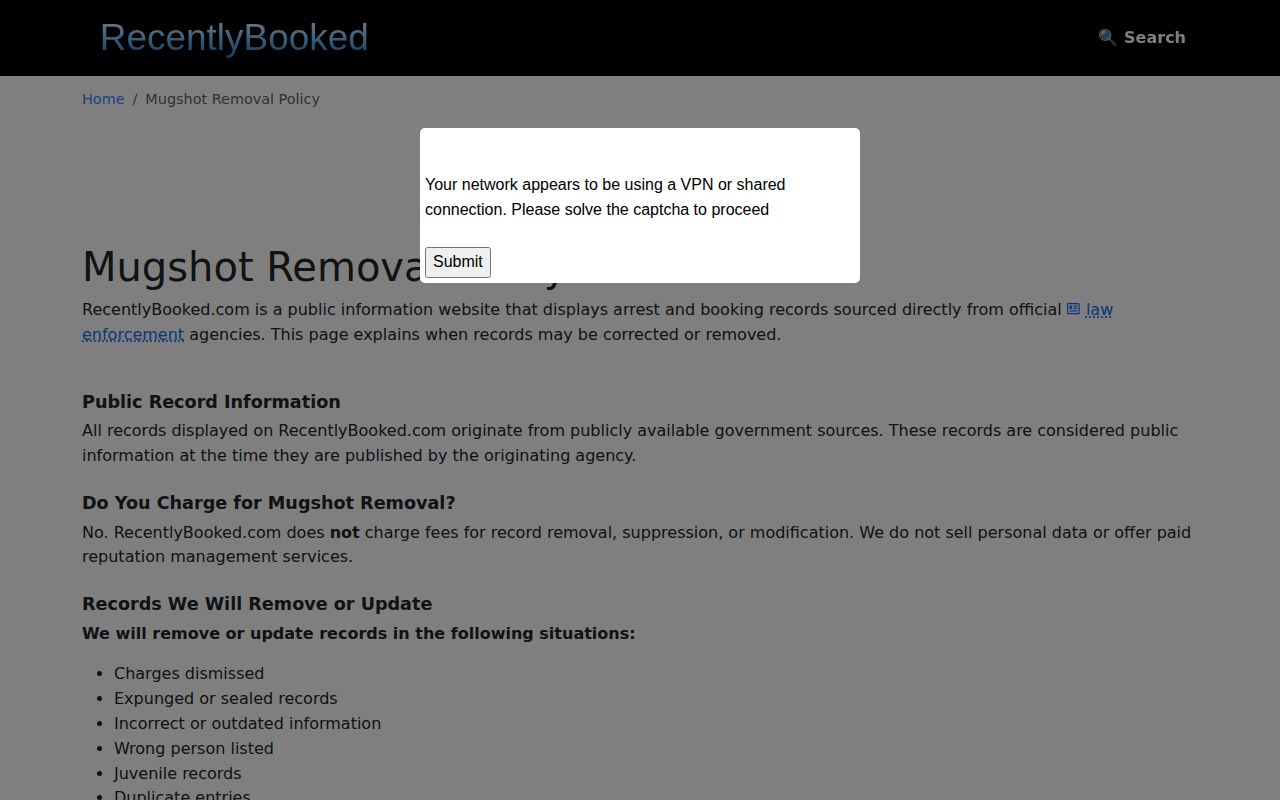
A screenshot shows a publisher's process, not a state order. Verify the arrest and outcome with the official custodian first. Do this especially where names or dates overlap. Mugshots.com's policy also takes free requests for certain documented cases and updates. That process is voluntary too. A correction there cannot remove copies other publishers hold.
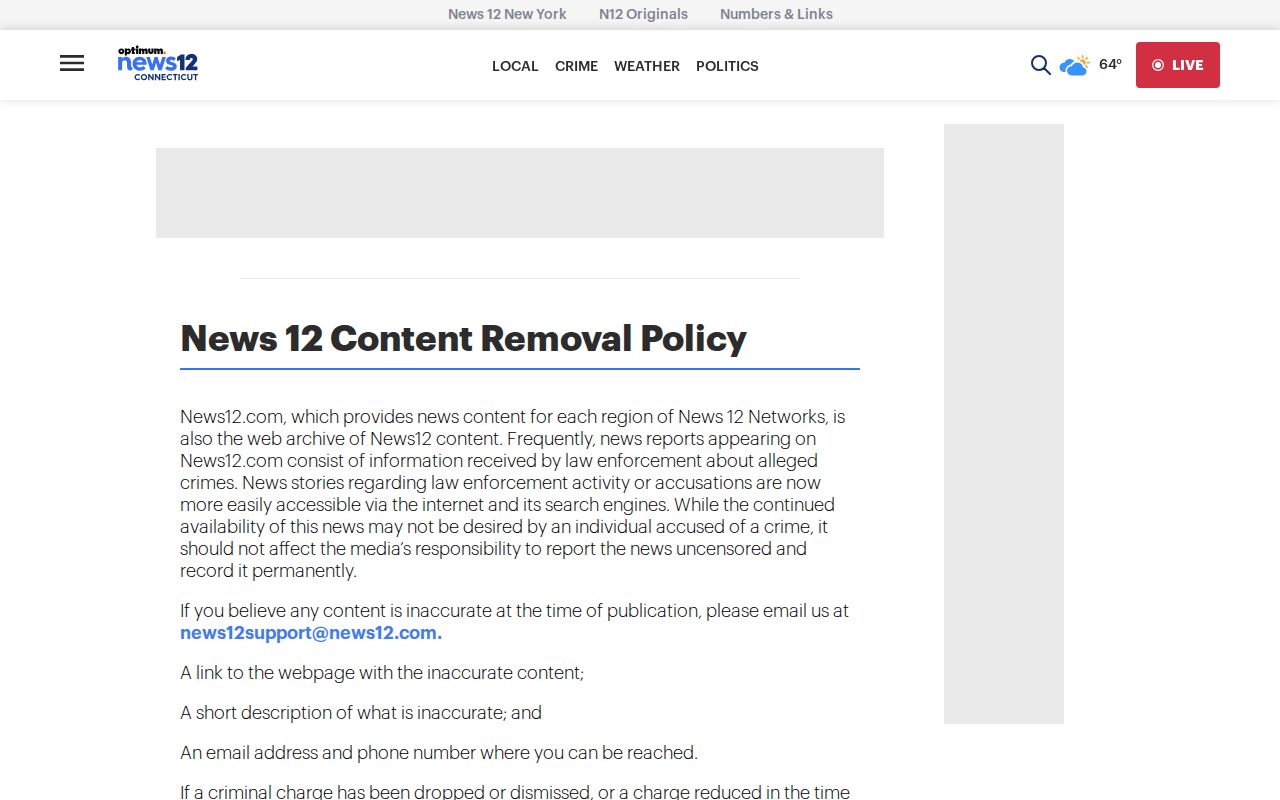
News 12 Connecticut keeps its original stories. It may add a verified disposition after a charge is dropped, dismissed, or reduced. Send the story link and court proof through the route its policy describes.
The News 12 policy explains its route for a documented update and states that an original story is not removed simply because an accusation later changes.
Send only the proof a review requires. Search results can lag behind a source update, and a search engine generally cannot alter the publisher's page.
Check Connecticut Case Status
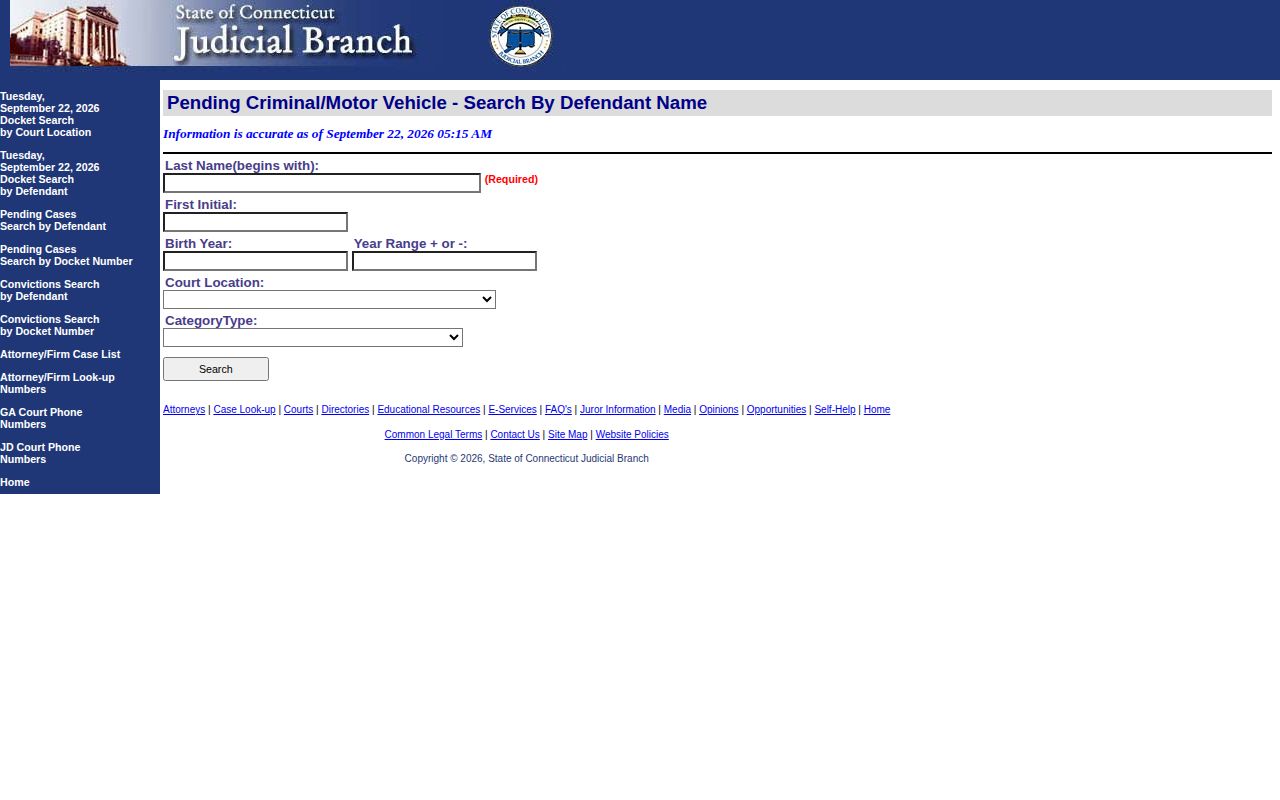
A case docket answers a different question than an arrest report or photo. The Connecticut Judicial Branch lookup locates pending cases and convictions. It searches by defendant or docket details. The tool is not a certified criminal-history record. Nor is it a complete arrest roster. A blank result may stem from erasure, youth confidentiality, a search mismatch, or portal limits.
The official Judicial Branch search form shows the fields used to locate a pending criminal or motor-vehicle case.
Route requests by type. The arresting agency holds the initial record. The court holds the disposition, which is the case's outcome, and CT DOC covers state custody. Connecticut has no county jail roster. The statewide arrest-search hub sorts readers among municipal feeds, court records, and custody systems. The CT DOC offender-photo page handles state prison records.
Ask the clerk or agency holding a document for a formal disposition. If erasure should have happened, turn to the Clean Slate or State Police process. A blank public search never proves a record failed to exist.