
Connecticut Wanted Systems
Connecticut has no statewide wanted index. No single source matches every active warrant to a booking photo, so several official channels split the work instead. The Office of Policy and Management (OPM) publishes warrant statistics supplied by law enforcement. The Department of Correction (DOC) runs a Parole Fugitive Investigations Unit. It handles parole absconders and selected high-profile matters. Town police departments post their own case notices. The U.S. Marshals Service (USMS) adds a federal task-force route, and the Division of Criminal Justice (DCJ) offers cold-case and reward information.
These lists do not overlap neatly. A DOC notice concerns supervision status. An OPM table just counts warrants. A court docket can trace a case, yet it cannot certify that a warrant is still active. A federal page may list contacts without any local profile. Start with whichever agency issued the notice or handles the case. For town and county police material, the County Directory routes you to the right locality site, though that local feed is not a complete warrant register either.
When a name or photo appears, open the agency's own page for its posted date, status, and contact path. Never assume a notice carries a fresh booking photo or a full case history.
For a picture of how one office presents this, the Connecticut DOC Parole Fugitive Investigations Unit page displays the agency's public fugitive information alongside its tip route. It is a contact resource. It is not a statewide mugshot search.
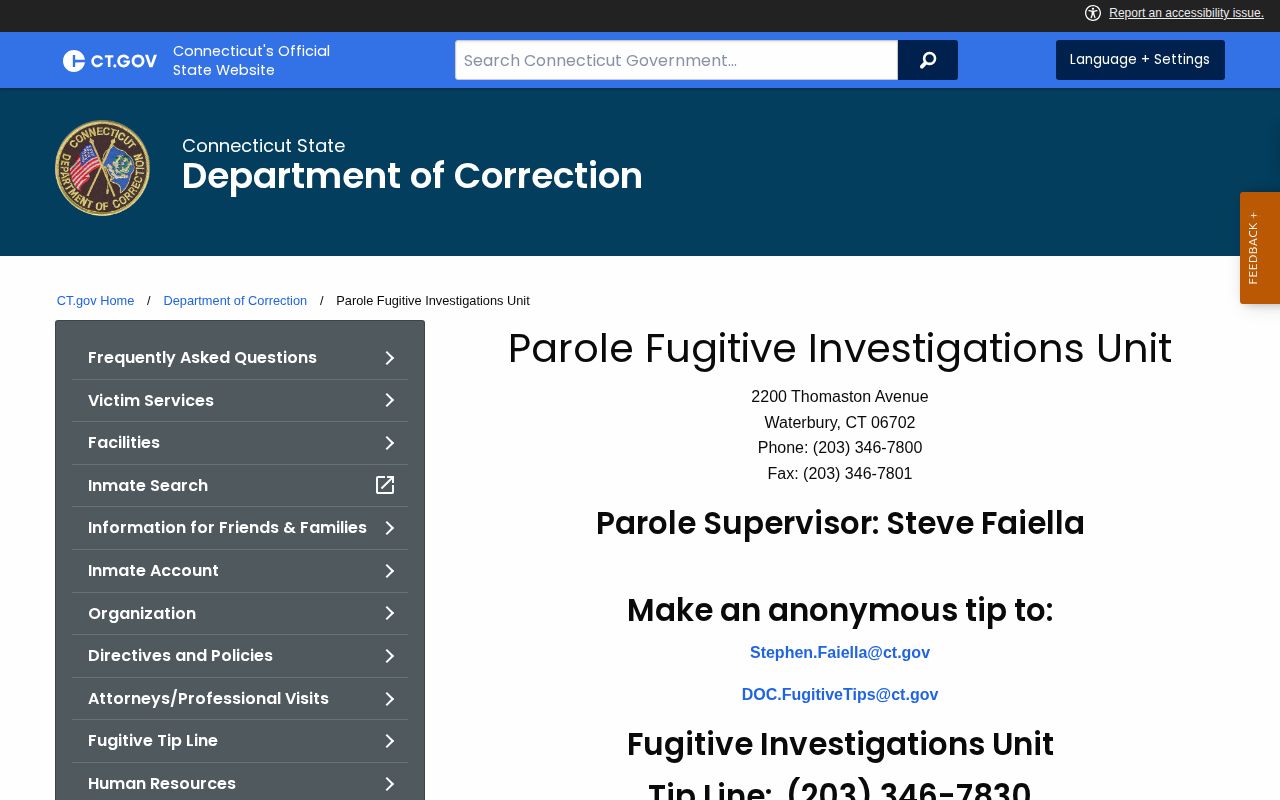
Use the live page for current directions. Phone and email details change, and the page covers selected DOC supervision matters rather than every arrest warrant.
Official Connecticut Fugitive Resources
The official channels below form a layered system rather than one complete statewide roster. Photos and case details vary by agency. Each office posts only what it chooses, so follow a source link to see who is named and when the information appeared.
| Resource | Who It Covers | Photo or Listing Scope | Key Limit |
|---|---|---|---|
| DOC Parole Fugitive Investigations Unit | Parole absconders, community-supervision escapees, and selected high-profile cases | Official fugitive information; case details depend on the current page | Not every warrant or a current-booking feed |
| OPM arrest-warrant data | Statewide figures and municipal tabulations supplied by law enforcement | Statistical tables, not individual mugshots | OPM cannot issue, enforce, change, or clear a person’s warrant |
| USMS District of Connecticut Violent Fugitive Task Force | Federal and local fugitive investigations handled by the task force | The reviewed district page showed no local profiles | A task-force contact page is not a statewide search form |
| DCJ cold-case investigations | Selected unsolved cases and related rewards or tip requests | Case-specific material, not necessarily a wanted notice | A cold-case listing does not establish an active warrant |
| Municipal or Connecticut State Police releases | Selected local or state investigations | Format and photo use vary by agency | There is no shared statewide release list |
There is no verified statewide active-warrant mugshot index. A public-facing agency notice can help identify the issuing office, but only that office or the court can address a specific person’s current status.
What a Connecticut Warrant Listing Shows
Connecticut agencies share no common wanted-list format. Some pages describe a unit's work and tip route. Others post a single case notice. A statistical table may show only a category, with no person named at all. Check the issuing agency and the exact wording before reading any field as proof of an active warrant.
| Detail to Check | What It Can Tell You | What It Cannot Prove |
|---|---|---|
| Issuing agency | Which office published the notice and should receive a tip | That another agency’s records match it |
| Person or case named | The subject the agency is asking the public to identify or locate | Guilt or the final court outcome |
| Warrant category, if stated | Whether the notice describes failure to appear, violation of probation, or another classification | A complete or current warrant history |
| Date or update note, if shown | How recently that page says it was reviewed | That the status remains unchanged today |
| Photograph, if included | The image the agency chose to publish for that notice | Identity by itself or a booking-photo record from every arrest |
Never fill gaps with a third-party repost. The image may be old, missing, or tied to a different event, so without a court number, date, or status on the official page, contact the named agency or get legal help. Guesswork helps no one here.
Check a Connecticut Warrant
Unsure about a possible warrant? Use a court or agency route tied to the known case. Then ask a lawyer or clerk how to proceed. OPM's public figures cannot say whether a named person has an active warrant. The state court case lookup shows docket information. But a search result is not a warrant-clearance certificate.
- Write down the name used in the court matter and any case number or court location already known. Do not rely on a name match alone.
- Search the Connecticut Judicial Branch criminal and motor-vehicle docket for the case and review its status. A docket is a case record, not a live statewide warrant search.
- Call or visit the relevant court clerk through the current contact information on the official court site, or speak with counsel. Ask which office can confirm whether a warrant is active and what kind it is.
- Follow the advice of counsel or the court about resolving it. Do not treat an online result as instructions to evade, approach, or confront anyone.
The state's public case search appears next. It connects a known case to docket activity. It does not replace direct confirmation with the court or issuing agency. Open the Judicial Branch docket search for the live interface.
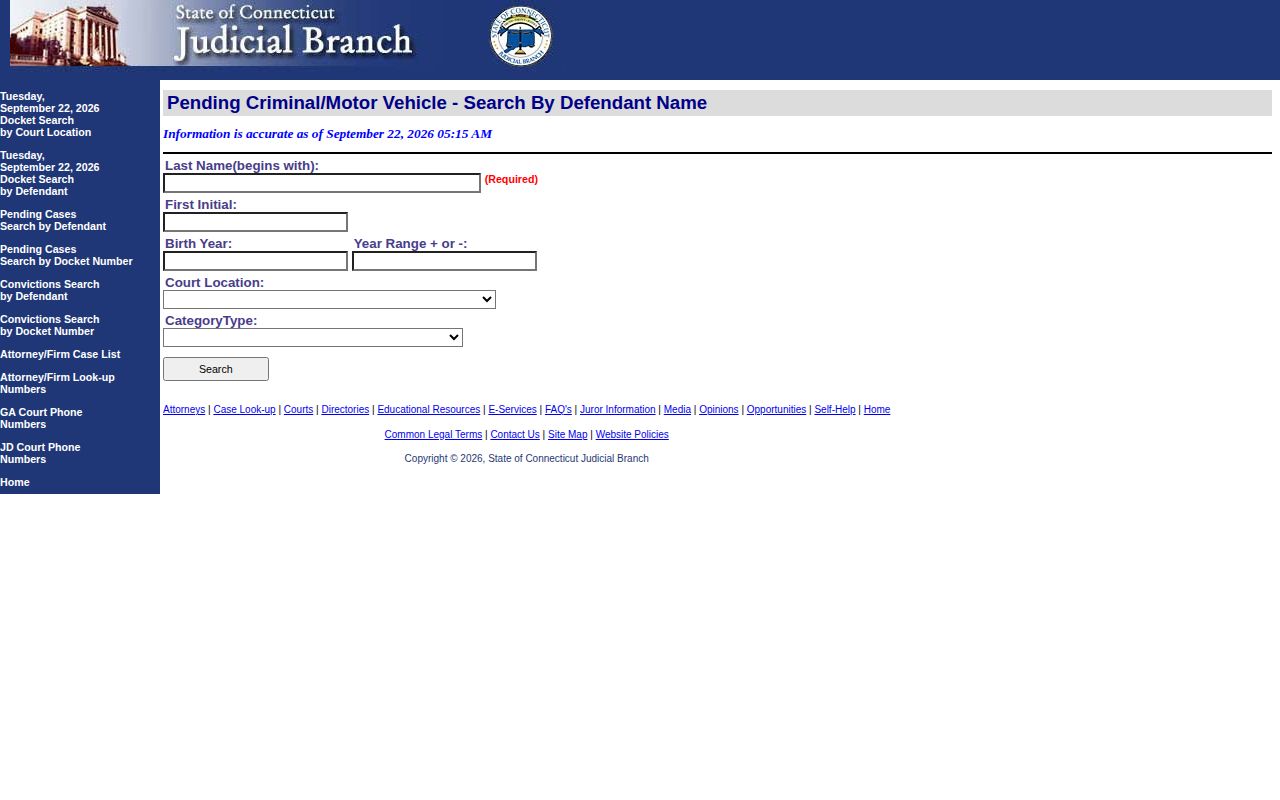
These fields support case lookup, not a warrant check. Confirm any result with the court before relying on it.
Connecticut Warrant Data Limits
Connecticut's Office of Policy and Management shares warrant figures with the public. The tables break counts into statewide totals and monthly municipal groupings. Categories include failure to appear, violation of probation, and other warrant classifications. They give a broad picture of how the state tallies warrant activity across towns. They will not find one person. No name search exists there.
OPM also defines its own role plainly. It does not issue, enforce, modify, or clear an individual warrant. So treat the numbers as background, not a live status tool. An older OPM report covering 2006 through 2016 adds historical context. It still cannot establish where a case stands today. Never assume someone has a warrant, or lacks one, because of a municipal count.
The data's backbone, the Paperless Arrest Warrant Network, serves law enforcement. PRAWN is not an open public lookup. Questions about your own case belong with the court, the issuing agency, or counsel. Read the OPM explanation of Connecticut arrest warrants alongside its warrant-data table above, and the PRAWN description for the system's official role.
Connecticut Warrant and Custody Searches
Two different questions, two different tools. The DOC offender search covers people in state custody right now. It skips many others. Not everyone with a warrant shows up, nor every recent arrest, nor every person under local supervision. Parole fugitive notices live on the DOC investigations channel. A custody result also leaves questions open, since it says nothing about why a person is held or what a court decided. The live Connecticut DOC inmate information search shows its current fields and scope notice. Trust the live page over any old screenshot.
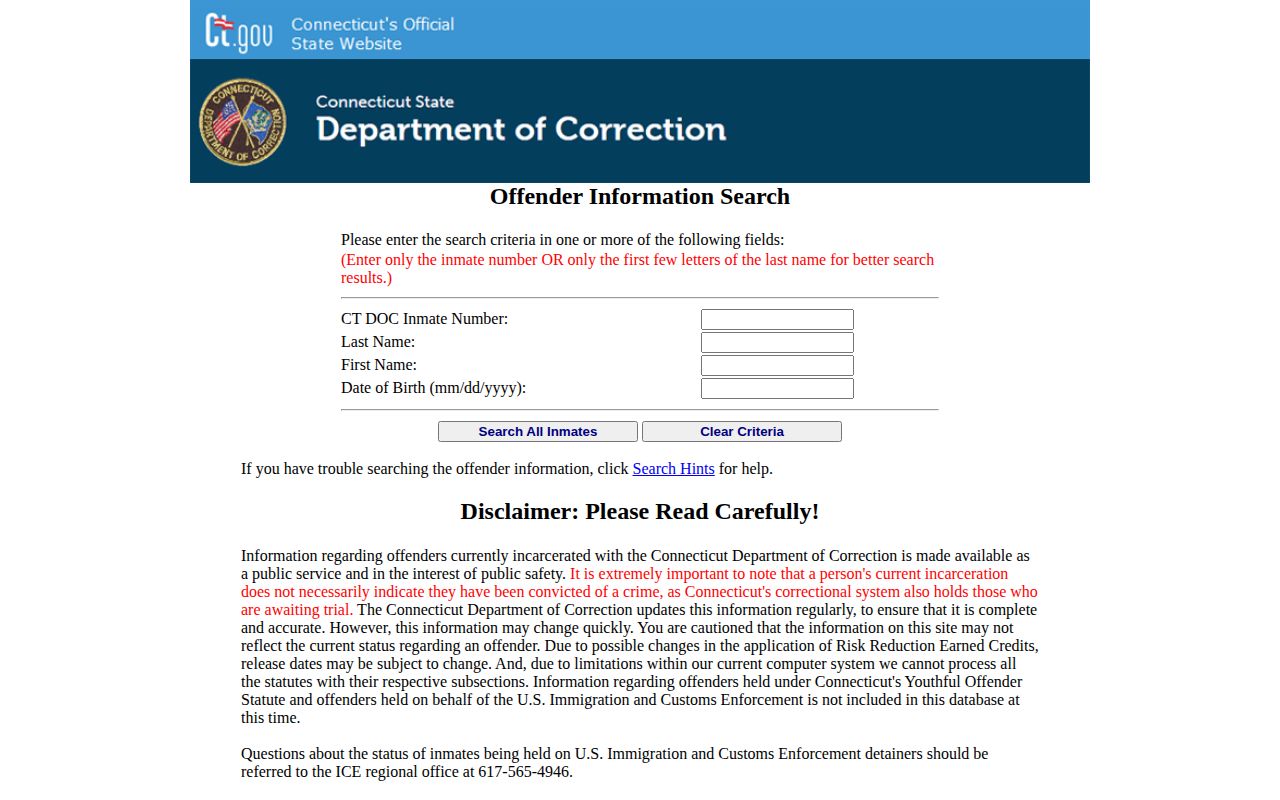
This form covers state custody, not warrants. It is no certificate of who is wanted. Someone can face a court matter while never entering DOC custody. Federal custody sits on yet another track. The Federal Bureau of Prisons locator helps identify people held federally, though it is not a Connecticut warrant directory and its public interface offers no mugshot field.
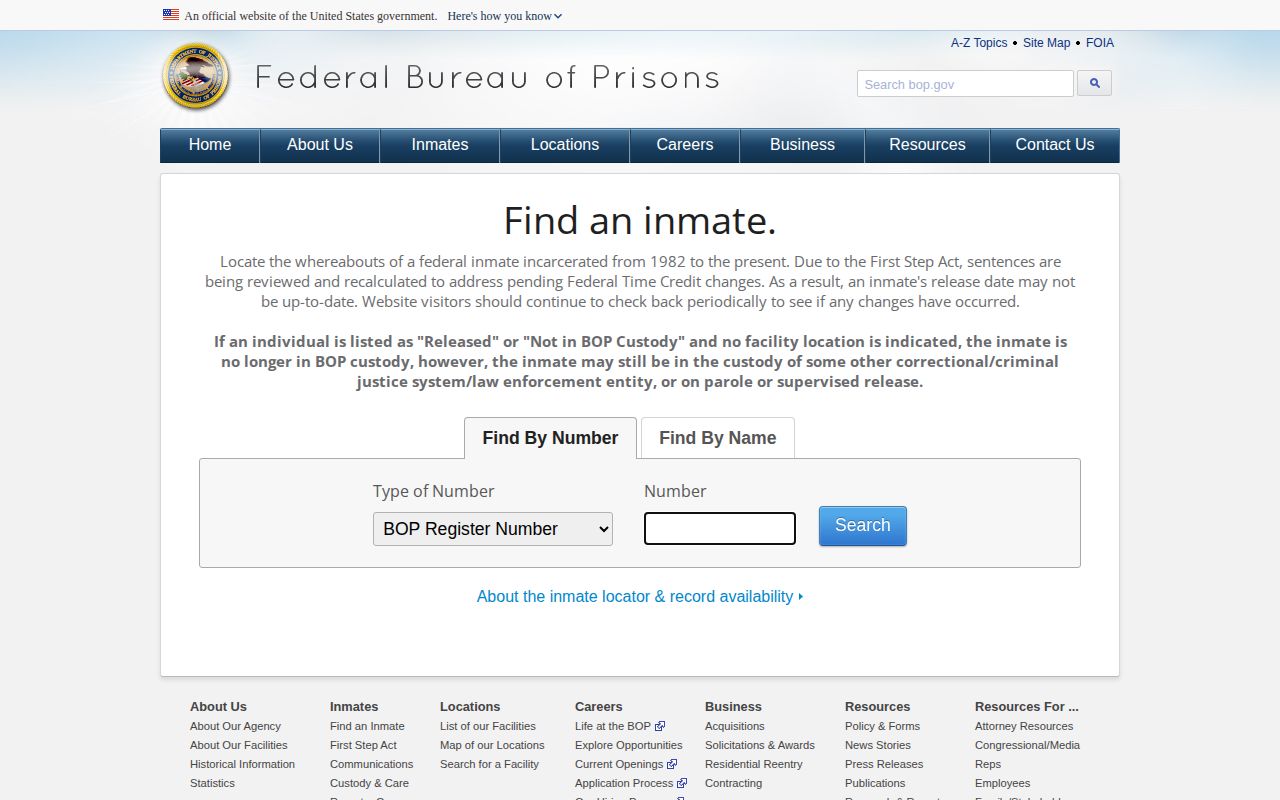
A federal locator result reflects federal custody only. It cannot confirm a state warrant or replace a court clerk's answer on a Connecticut case.
Alerts Are Not Fugitive Lists
CT SAVIN/VINE is a victim and custody-notification system. It is not a mugshot feed. It is not an active-warrant search either. Registered users can receive notice of custody events, and the state DCJ resource page links to the service. Its purpose is delivering relevant updates, not publishing every booking.
CT Safe plays a different role altogether. It collects suspicious-activity reports. It is no roster, no fugitive gallery, and no way to check a court case. Town emergency alerts sit apart from jail and warrant records too. Facing immediate danger? Call 911. A non-emergency tip about a named fugitive belongs on the official page of the agency running that investigation.
The distinction matters in practice. A notification service reports custody changes to a registered user, while a wanted notice seeks tips on one specific investigation. Neither changes the legal status of a case, and neither replaces the court record. Use the official CT SAVIN/VINE service for victim and custody notices, or review the CT Safe guidance for suspicious-activity reports.
Report Tips Safely
Send tips to the agency that posted the notice. DOC's Fugitive Investigations Unit takes information on its own cases. The unit and contact pages hold the current route. Phone details shift. So use the live page rather than a copied number. Never presume a reward unless the official case notice says one is offered. Follow this short process when a notice asks the public for help:
- Open the official agency page and confirm that the notice is still posted.
- Use the tip method listed on that page, such as its current online form, email, or phone route.
- Share only what you directly know. Do not follow the person, seek more information in person, or post a live location online.
- If there is an immediate threat, contact emergency services instead of waiting for a web form or tip inbox.
Official tip route
Connecticut DOC Parole Fugitive Investigations Unit
Current contact methods: DOC contact information
The unit's official page, linked above, posts the case details.
DCJ's cold-case page runs its own state tip route for the cases it lists. That line covers only those posted cases. It cannot stand in for a DOC or local police contact when a different agency owns the investigation. Check the table above for the current contact path.
Safety and Innocence
Wanted notices ask for tips. They grant no police powers to the public. Never approach, follow, surveil, or confront anyone an agency names. Do not detain them. Do not post a live location or rally others around a person. Send the tip through the official route and let trained officers judge it.
Safety: Call 911 for any immediate threat. Otherwise, use the contact route on the agency's official notice, and never pursue or confront a person shown on a fugitive page.
Warrant and fugitive listings raise practical questions fast. Where a person falls in the process matters. The Connecticut busted mugshots search overview sorts out those distinctions. It shows how a booking record, a court case, and a later custody record differ. Each one answers a different question.
Safety first: Treat any listing here as a starting point, not a conclusion. The court record holds the fuller account.
Verify before you act. Check the agency's current page. The court's own case record, plus a call to the court clerk or a lawyer, marks the safe official path for any specific person.